What Is Dynamic Range in Photography? Blown Skies and Crushed Shadows Explained
Dynamic range is the span between the brightest and darkest detail a camera records in one exposure — the reason skies blow out and shadows turn noisy.
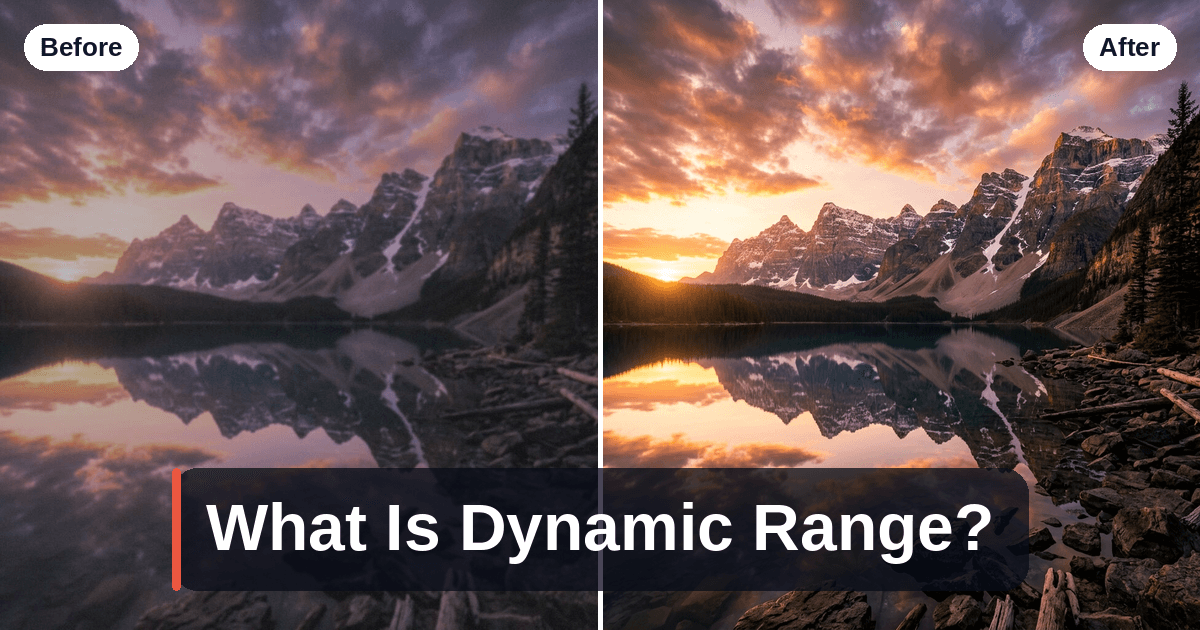
Dynamic range is the ratio between the brightest and darkest detail a camera can record in a single exposure, measured in stops. When a scene holds more range than the sensor can capture, something has to give: the sky flattens into blank white, or the shadows collapse into black mush. Almost every disappointing phone photo — the white sky behind a friend, the window that became a glowing rectangle — is a dynamic-range failure, not a focus failure.
Stops: the unit that makes dynamic range measurable
A stop is a doubling or halving of light. Stops keep the numbers readable: 12 stops means a sensor can record a highlight roughly 4,000 times brighter than its darkest usable tone (2¹² = 4,096).
Roughly, in the real world:
- A typical phone sensor: about 10–12 stops in one RAW exposure.
- A large-sensor mirrorless or DSLR: about 13–15 stops.
- Human vision: roughly 14 stops at any instant, more as your eyes adapt — which is why the scene looked fine to you and wrong in the photo.
- A backlit outdoor scene: easily 15–20 stops from the sunlit sky to the shade under a hat brim.
That last line is the problem: scenes routinely hold more range than a camera can capture at once, and the smaller the sensor, the sooner it runs out. Bigger photosites saturate later, so a large sensor genuinely has more dynamic range than a phone — software does not repeal that, it works around it. (See phone camera vs DSLR.)
Highlights clip forever; shadows only get noisy
The two ends fail in completely different ways — the most useful fact in all of exposure.
Each photosite is a bucket that counts photons, with a full-well capacity: a ceiling. Once full it cannot count higher, so every pixel past that ceiling records the identical maximum value — a bright cloud, a much brighter cloud and the sun all become the same number. That is clipping, and no slider recovers it, because there is no data left, only a flat plateau.
Shadows fail more gently. The signal is recorded, just very small, sitting close to the sensor's read noise. Lift them in editing and you amplify that noise too: grain, blotches, colour shifts. Ugly, but recoverable up to a point. Hence the rule photographers repeat: expose for the highlights, lift the shadows.
RAW widens the margin: a JPEG is already compressed to 8 bits with a tone curve baked in, while RAW keeps the sensor's full 12–14-bit range, so a highlight clipped in one colour channel alone can sometimes be pulled back.
The scenes that break cameras all share one shape — a small very bright region beside a large much darker one.
How multi-frame capture works around the limit
If one exposure cannot hold the scene, take more than one. Three approaches, not equally good:
| Approach | How it captures | Dynamic range | Weakness |
|---|---|---|---|
| Single exposure | One frame, one set of settings | The sensor's own (~10–12 stops on a phone) | Clip the sky, or crush the shadows — pick one |
| Bracketed HDR | Three or more frames at different exposures | Wider — a dark frame holds the sky, a bright one the shade | Ghosting on anything that moves; slow |
| Multi-frame merge (HDR+ style) | A burst of short frames at the same, deliberately dark exposure | Wider, with far less shadow noise | Needs alignment and compute; still bounded by the sensor |
The third is what modern phone cameras use, and the reasoning is elegant. Every frame is deliberately underexposed, so nothing clips — highlights are safe by construction. Those frames have dark, noisy shadows, but random noise averages out across a stack: merge enough aligned frames and noise falls roughly with the square root of the frame count, so the shadows lift cleanly. It is the same multi-frame method Google Pixel and iPhone cameras use, the core idea behind computational photography, and why night photos on a phone work at all.
Tone mapping: the step everyone actually blames
After a merge you hold more range than any screen or JPEG can show — a standard 8-bit image displays roughly 8 stops. Compressing the merged data to fit is tone mapping.
A global tone curve adjusts everything equally. Local tone mapping works region by region: pull the sky down, lift the face. Done well, the result just looks like a photo in which you can see both.
Done aggressively, it produces the effect people mean when they say they hate HDR: global contrast gets spent, everything drifts toward mid-grey, bright halos appear along high-contrast edges like a roofline against sky, and textures turn crunchy. Place the blame precisely, though: that look is a finishing choice, not a property of the merge. The extra range is real data, and grey and over-cooked is only one way of rendering it — which is why avoiding an over-processed look is a separate question.
How to read a histogram
A histogram plots how many pixels fall at each brightness level: dark on the left, bright on the right, height is pixel count. Four things to look for:
- A tall spike against the right edge — clipped highlights. Data gone. Cut exposure or shorten the shutter.
- A spike against the left edge — crushed blacks. Sometimes intentional (night sky, black backdrop), often just underexposure.
- Two humps with a valley between — the bright-sky-and-deep-shade scene rendered as data, and the signature of a shot that needs a merge.
- The per-channel view, not just luminance — a red flower or a sunset often clips red while overall brightness still looks safe.
In practice: expose so the right end stops just short of the wall, then let the merge lift the shadows.
Why SensePose
SensePose works on dynamic range at both ends of the pipeline. Every capture shoots a burst of RAW frames and merges them on-device — the same multi-frame HDR+ method behind Pixel and iPhone cameras — for the wider dynamic range and cleaner shadows a multi-frame merge gives you, on hardware that shipped without it. The small sensor still holds less range than a large one; merging works around that limit rather than erasing it. A real-time AI Pro Mode sets ISO, EV, aperture and shutter live, with a histogram and preview, so you can watch the highlights before you commit. An opt-in cloud step finishes with 2× AI upscaling and a cinematic tone grade. Pro Mode, the merge and full-resolution export are free forever, plus 10 cloud AI enhancements a month; free exports carry a small watermark a Pro plan removes, and the app takes a one-time Google sign-in. It runs on any Android 10+ phone at around 28 MB and is on Google Play — see also our roundup of the best AI camera apps for Android.
FAQ
What is dynamic range in photography?
Dynamic range is the ratio between the brightest and darkest detail a camera can record in one exposure, measured in stops. A scene with more range than the sensor can hold forces a choice: clip the highlights to white, or let the shadows fall to black. It decides whether a bright sky and a shaded face can both look right in one photo.
What does "stops of dynamic range" mean?
A stop is a doubling or halving of light, so each extra stop doubles the brightness span a sensor can record — 12 stops means a highlight about 4,000 times brighter than the darkest usable tone. Phone sensors typically manage 10–12 stops in a single RAW exposure; larger camera sensors reach roughly 13–15.
Why do bright skies turn white in phone photos?
Because the sensor's photosites saturate. Each one counts photons only up to a ceiling, and everything past it records the same maximum value, so cloud detail flattens into one tone. It happens whenever the sky is many stops brighter than the subject — most often when you shoot a person with the light behind them.
Can you recover a blown-out sky?
Not from a truly clipped area, because no detail was recorded there — only a plateau of maximum values. RAW helps at the margin: a highlight that clipped in one colour channel alone can sometimes be pulled back a fraction of a stop. The reliable fix is at capture — expose lower, or use a multi-frame merge that keeps every frame dark enough to clip nothing.
What is the difference between dynamic range and HDR?
Dynamic range is a property of the scene and the sensor; HDR is the technique for capturing more of it. HDR merges several frames into an image with more range than one exposure could hold, then tone-maps that data down so an ordinary screen can show it. The flat, grey "HDR look" people dislike comes from over-aggressive tone mapping, not from the extra range itself.
Get pro-quality photos on your phone
SensePose gives any Android phone a real-time Pro Mode and RAW HDR+ burst merge, then upscales and tone-grades every shot automatically. Free on Android.