What Is RAW HDR+? Multi-Frame Merging Explained
RAW HDR+ is a burst technique that merges several unprocessed RAW frames into one photo, cutting noise and recovering highlight and shadow detail.
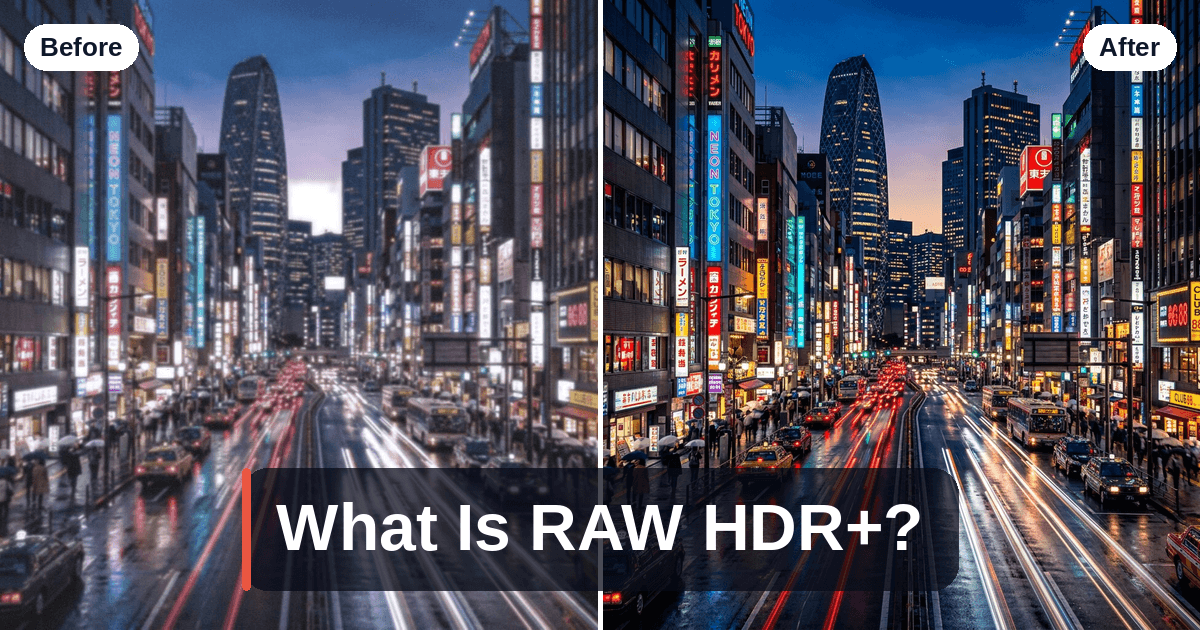
RAW HDR+ is a photo technique that merges a burst of unprocessed RAW frames into one image with less noise and wider dynamic range. It is the mechanism behind almost every "how did my phone do that?" moment of the last decade — night mode, clean shadows, skies that aren't blown out. The name comes from Google's HDR+ pipeline, first shipped on Nexus and Pixel phones, and the same multi-frame approach underpins iPhone capture. It is the central idea in computational photography.
What a burst is, and why RAW matters
Tap the shutter on a multi-frame camera and you aren't taking one photo. The camera is already running a rolling buffer, and keeps the handful of frames captured around your tap — typically 3 to 15, all at the same short exposure, inside a fraction of a second.
RAW means those frames are the sensor's own readings: 10- to 14-bit linear values with no white balance, tone curve, sharpening or noise reduction applied. Linear is the operative word — a RAW value is proportional to the photons that hit that pixel, so adding RAW frames together means something physically. JPEG values have already been through a gamma curve, sharpening and denoising; stacking those compounds whatever the first pass got wrong.
Burst means the frames are near-identical rather than bracketed, and this is the counter-intuitive part. Classic HDR shoots one dark, one normal and one bright frame and blends them. HDR+ instead shoots every frame deliberately underexposed, short enough that even the bright parts stay below clipping, then recovers the shadows after merging. Protect highlights in hardware, because a clipped highlight is gone forever; fix shadows in software, where merging can actually help.
Why merging frames cuts noise
The grain in a dark photo is mostly shot noise: light arrives as discrete photons, and the count landing in any pixel during a short exposure fluctuates randomly. Fewer photons, noisier estimate.
The signal is the same in every frame of a burst; the noise is different, and random. Average them and the signal stays put while the noise partially cancels — the random component falls roughly with the square root of the frame count. Four frames roughly halve it; sixteen roughly quarter it. That's why a merged stack survives being lifted several stops in the shadows, and why night modes spread light-gathering across many frames rather than one long, blur-prone exposure — the trade-off behind night photography on Android and low-light camera apps.
How a merge recovers highlights and shadows
Dynamic range is the distance between the brightest and darkest detail a photo can hold. A single short frame protects the sky but buries the shadows in noise; a single long frame opens the shadows but clips the sky to flat white.
A merge escapes the choice. Because the stack is far cleaner than any of its members, you can expose for the highlights and brighten the dark regions afterwards, which the merged noise floor can absorb.
| What changes | Single RAW frame | RAW HDR+ merge |
|---|---|---|
| Shadow noise | Full sensor noise; limits how far you can lift | Falls roughly with √(frames); shadows survive lifting |
| Highlights | Must expose brighter, risking a clipped sky | Every frame underexposed, so highlights stay intact |
| Dynamic range | Bounded by one exposure | Wider, because clean shadows can be recovered |
| Fine detail | Whatever one frame caught | Sub-pixel shifts between frames add real detail back |
| Moving subjects | Frozen exactly as shot | Risk of ghosting; needs motion-aware merging |
| Capture time | One exposure | Longer — the burst must complete |
The hard part: alignment and ghosting
Averaging frames is arithmetic. Deciding which pixels to average is the engineering problem. Between frame one and frame eight, your hands moved — and so did the leaves, the traffic, and the person you're photographing. Average misaligned frames directly and you get a blurry, double-exposed mess, worse than a single shot.
So a real pipeline does three things first. It picks a reference frame, usually the sharpest of the burst. It aligns the others in tiles rather than as whole images, so a shaken frame can be nudged into place region by region at sub-pixel precision. And it merges robustly: where a tile disagrees badly with the reference — a car moved, a branch swayed — that frame's contribution is reduced or dropped.
That last step is ghost suppression, and it has an honest cost. A region where motion was detected merges fewer frames, so it gets less noise reduction than the static parts of the scene. Push too hard on a moving subject and you see the failure directly: a faint second copy of a limb, a smeared hand.
Why it works on a tiny phone sensor
A phone sensor is at a huge physical disadvantage — the reason a big camera still wins on single-exposure quality, as covered in our phone camera vs DSLR comparison. You can't make the sensor bigger. But light collected is area × time, and multi-frame capture buys back the time axis: ten frames gather roughly ten frames' worth of light with no single exposure long enough to blur.
That's the whole trick. A merge spends what phones have plenty of — compute and a few hundred milliseconds — to buy what they lack, sensor area.
What RAW HDR+ cannot do
- Fast motion. A burst takes time. Sports, kids and moving vehicles give the merger less to work with, and motion regions end up noisier.
- Diminishing returns. Noise falls with the square root of frame count, so 4 frames to 16 costs 4× the capture time for half the noise — while the odds of something moving rise the whole way.
- Clipped is clipped. If a highlight is blown in every frame, no merge brings it back. Hence the deliberate underexposure.
- It won't fix focus or bad light. Merging improves noise, dynamic range and detail — not a missed focus or flat lighting.
- Power and heat. Aligning and merging RAW frames is real computation.
Why SensePose
Most Android phones have a sensor perfectly capable of feeding a burst merge, and a stock camera app that never does one. GCam ports are the usual workaround, but they lock you to auto exposure and often wash out color on non-Pixel hardware; ProShot and Open Camera give you sliders but no AI — a gap covered in our GCam vs AI camera app comparison.
SensePose runs the RAW HDR+ burst merge on-device, on hardware that shipped without it — the same multi-frame method Pixel and iPhone cameras use, for the lower noise and wider dynamic range a merge gives you. Feeding it is a real-time AI Pro Mode that reads the scene and sets ISO, EV, aperture and shutter live, the way a photographer would, so the burst is exposed correctly before merging. Optional cloud steps add 2× AI upscaling and cinematic tone grading.
Pro Mode, the merge and full-resolution export are free forever, plus 10 cloud AI enhancements a month; free exports carry a small watermark a Pro plan removes. A one-time Google sign-in is required, after which capture and the on-device merge work offline. It runs on any Android 10+ phone at around 28 MB. SensePose is an AI camera app first; its optional, experimental framing coach is a secondary feature, and it's on Google Play.
FAQ
What is RAW HDR+ in simple terms?
RAW HDR+ is a capture technique that shoots a rapid burst of unprocessed RAW frames and merges them into one photo. Because the random noise differs in every frame but the scene does not, averaging cancels much of the noise — which lets the camera underexpose to protect bright highlights and brighten the shadows afterwards.
How is RAW HDR+ different from regular HDR?
Regular HDR brackets exposures: one dark, one normal and one bright frame, blended. That handles contrast but does nothing for noise, and ghosts easily because the frames differ so much. RAW HDR+ shoots many frames at the same short exposure so highlights never clip, merges them to cut noise, then lifts the shadows computationally — on linear RAW sensor data rather than already-processed JPEGs.
Does RAW HDR+ work in low light?
Yes, and low light is where it helps most. In dim scenes shot noise dominates, and averaging frames is one of the few ways to reduce it without a long exposure that would blur from hand shake. A burst gathers many frames' worth of light while each frame stays short enough to be sharp. The limit is motion: subject and photographer need to be reasonably still.
Why do merged photos sometimes show ghosting?
Ghosting happens when something moves between frames and the merger blends the mismatched positions together, leaving a faint second copy or a smeared edge. Good pipelines detect this by comparing each frame tile against a reference frame and dropping tiles that disagree. That suppresses the ghost, but those regions merge fewer frames, so moving parts of a photo end up noisier than the static background.
Does RAW HDR+ need a flagship phone?
No. The technique needs RAW frame access through the camera API and enough compute to align and merge a handful of frames — not a dedicated imaging chip. Plenty of mid-range and budget phones can run a burst merge; most simply ship a camera app that never attempts one. SensePose performs the merge on-device on any Android 10+ phone, with no flagship silicon required.
Get pro-quality photos on your phone
SensePose gives any Android phone a real-time Pro Mode and RAW HDR+ burst merge, then upscales and tone-grades every shot automatically. Free on Android.